.png)
EXPRESSING YOURSELF THROUGH ART
Art is that form of creativity which transforms itself into whatever its creator chooses. It is a process that can emerge and take root in the soul like a substance of pure passion. If you were to ask me, I would say that we all possess the power to create—to manifest the sentiments of those pillars that constitute our very souls.
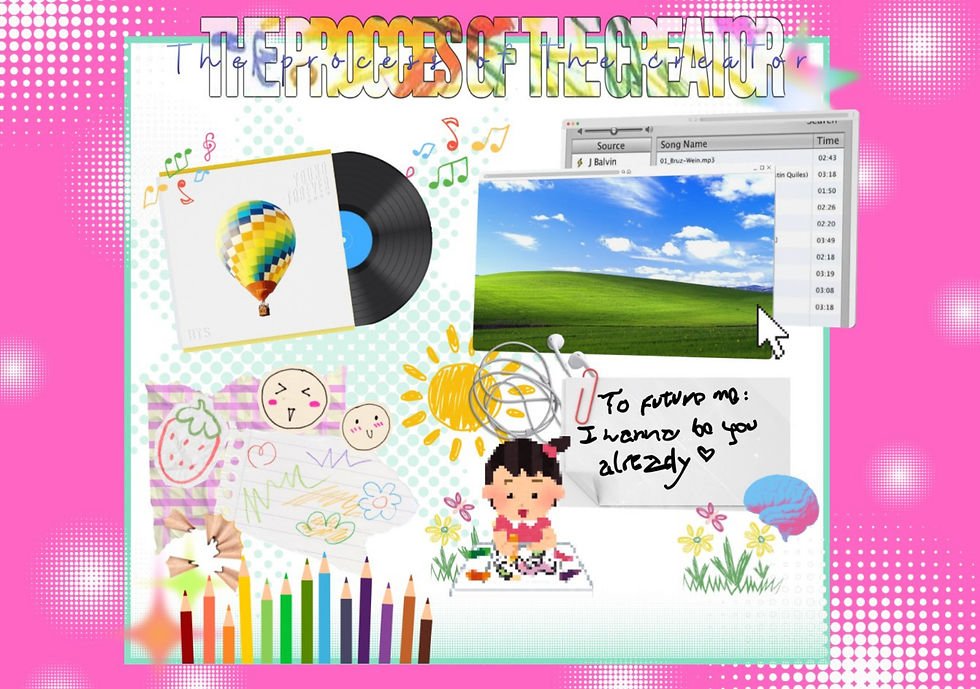
Since childhood, I have harbored a love for drawing. As I began to develop a certain talent, I would receive comments such as, "You should become an animator," or "You ought to start selling these." Yet, from that very moment, nothing contributed more to my eventual, long-term loss of interest in drawing than those very remarks. The mere thought that I could turn my hobby into my job caused me to lose the sense of freedom with which I had previously viewed it; my childlike perspective was exchanged for a sense of responsibility—a burden that ultimately extinguished the interest I once held. "Disillusionment" would be the most fitting word to describe what seems to have transpired within those hazy memories of my childhood. However, the dynamic shifts when the subject involves matters external to oneself. The societal patterns that govern us mirror this very phenomenon: a loss of interest whenever art becomes inextricably linked with the artificial. In industries such as cinema, audiences are quick to recognize when companies manufacture a product with an underlying financial motive, and they waste little time in branding it as "inauthentic." Many examples spring to mind, and I cannot help but dwell on one particularly significant instance: Disney and its desperate, ongoing attempt to churn out sequels and sagas rather than creating fresh, innovative works. We seem to be living in a paradox—one in which the collective rejection of such products swiftly propels them toward failure.
But where, exactly, does passion originate? Works such as The Passions of the Soul by René Descartes seek to expand upon the theory of human emotion, endeavoring to explain the why behind human actions—moving beyond mere biological determinism to focus instead on the realm of conscious experience. These are questions that arose long before the time of philosophers such as Plato. Countless works of literature and philosophy have grappled with this very question in myriad ways. Authors such as Virginia Woolf, for instance, describe it as a moment of profound liberation and intimacy with oneself—a privilege, she notes, that not everyone is afforded, particularly when it comes to women. While authors such as Friedrich Nietzsche viewed it as a motivation to justify our existence—and in light of these and many other ideas—the process through which all these works relate to one another is what I shall term: “the creator’s process.” Throughout this reading, you will help me formulate a more concrete definition for this new term. Beginning from a more ‘cerebral’ standpoint: what is passion? The definition provided by a neuroscientific study titled “The Speed of Passionate Love” describes it as: “a state of intense longing for union with another that is characterized by a motivated and goal directed mental state.” And although that particular study focuses specifically on ‘love,’ one could argue that love and passion amount to the same thing: motivation. Motivation serves as the foundation for passion or love—a force that can manifest in myriad ways—yet for the purposes of this, we shall focus on creation and creativity. Creativity “involves the development of a novel product, idea, or problem solution that is of value to the individual and/or the larger social group”; indeed, thanks to our creativity, we have been able to survive throughout the many millennia of human history—and it should truly be a source of pride for every individual to possess the capacity for thought and creation.


